
Description
This e-reader file is in EBK format and requires the downloading of our free e-reader software called the ‘IMO Bookshelf’ to view the file. Once you have purchased this title you must go to ‘My Account / Downloads’ and then ‘E-books, E-reader files & Subscriptions’. You will then be transferred to our Virtual Publications site where you can click on the product hyperlink and follow 3 easy steps to access your title.
For detailed instruction please copy and paste this link www.imo.org/Publications/Documents/FAQ/E-reader_instructions_page.pdf. Please be aware that the e-reader software and any purchased titles are locked to a single computer. Only 75% of the text can be printed per day and it cannot be printed as a pdf.The e-reader software is for Windows use and MAC users need to use a Windows emulator (eg Boot Camp or Parallels Desktop) in order to view the files.
When purchasing more than one digital copy, a 50% discount applies for each additional copy bought per site (i.e. office, terminal, ship or port) at point of purchase. To receive your multi-licence discount please email [email protected].
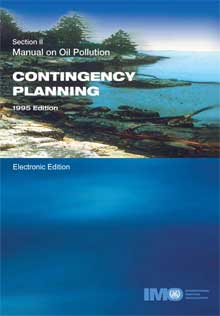
The 1995 edition of Section II supersedes the 1988 edition. It provides guidance to governments, particularly those of developing countries, on ways and means of establishing a response organization and preparing contingency plans.
The new edition takes into account the International Convention on Oil Pollution Preparedness, Response and Co-operation (OPRC), 1990, and other new developments in oil pollution emergency preparedness and response. Chapter 1, which deals with response, introduces the new organizational concept of a tiered response, according to the severity of the spill. Subsequent chapters mirror the escalation of activity, beginning with guidance on local contingency plans (chapter 2) and continuing with national response (chapter 3) and international agreements designed to cover operational aspects of the rare, catastrophic spill (chapter 4). Finally, chapter 5 provides specific guidance on intervention and cost recovery from spills arising from shipping accidents.

 Chat Now